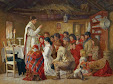
I'd like to wish the two or three people who wander by here a Happy New Year and a Blessed Epiphany. We call the latter Women's Christmas or Nollaig na mBan in this part of Ireland. I told my parishioners that today is a lovely day to give thanks again for Christ's coming among us as Light to the Nations in a more low-key and demanding way than Christmas Day itself. (Thus, Women's Christmas when busy mothers should have the chance to have a rest a celebration.)
In parish news, we had a most unusual group of people auditioning for our choir recently:
Alas, it's not quite what we're looking for.
Thursday, January 6, 2011


Friday, December 24, 2010
An extract from my Christmas Morning Homily
And he dwelt among us. Literally, in the Greek, it says, he set up His tent among us. He threw his lot in with us. It wasn’t just that he passed through – making an appearance and then vanishing like a shooting-star making its way across the heavens. That would make the Incarnation, the Word becoming Flesh, a wonder – something to be commemorated, but not the mystery we celebrate today. No, He became one of our tribe in such a way that our sufferings are His sufferings, our victories are His victories. When he ascends to the right hand of the Father, it is not to abandon us, but rather, to lead us on that same journey. The manner of His coming shows what He intends. He wasn’t born in a palace or behind closed doors. He wasn’t insulated from the hardships of life. He came among us in a stable where poor shepherds and wise Kings found an equal welcome. He came to us as a child – so that instead of putting fear into our hearts, He might draw love out of them instead.
Sunday, December 19, 2010
The mask slips...
From Saturday's Irish Times, Senator Joe O'Toole displays his anti-Catholic bigotry:
Pope Benedict very presciently noted last week:
Catholics should expect more of this. Don't let the politicians get away with it.
“One mention of pregnancy termination and the church leadership is galvanised into action. The Minister for Foreign Affairs should be asked to send a cable to Armagh on where it is we stand, and let the cobbler stick to his last. They can do the praying up there and we’ll do the legislating down here, thanks very much.”One wonders whether such discourse about any other religious group would be tolerated? That reference to the Minister of Foreign Affairs sending a cable to the North betrays a less than respectful attitude to our brethern on the other side of the border. One wonders whether Senator O'Toole also has a gripe about the fact that our current President is a Northerner? (I could also be pedantic and point out that Cardinal Brady is a Southerner by birth and that his diocese straddles the border.)
As John Hanafin (FF) had stated, we were an independent republic, and we would do our own business, added Mr O’Toole. “We won’t be lectured to by any fundamentalist whether he is wearing a red hat in Armagh or a white hat in the Vatican . . . This is not an issue of abortion. This is an issue of protecting pregnant women whose lives are in danger.
Pope Benedict very presciently noted last week:
There also exist – as I have said – more sophisticated forms of hostility to religion which, in Western countries, occasionally find expression in a denial of history and the rejection of religious symbols which reflect the identity and the culture of the majority of citizens. Often these forms of hostility also foster hatred and prejudice; they are inconsistent with a serene and balanced vision of pluralism and the secularity of institutions, to say nothing of the fact that coming generations risk losing contact with the priceless spiritual heritage of their countries.
[snip]
I also express my hope that in the West, and especially in Europe, there will be an end to hostility and prejudice against Christians because they are resolved to orient their lives in a way consistent with the values and principles expressed in the Gospel.
Catholics should expect more of this. Don't let the politicians get away with it.
Wednesday, December 1, 2010
A curate's egg from the Irish Catholic...
The editorial in the Irish Catholic is somewhat of a mixed bag this week - Garry O'Sullivan does make a good point about the usefulness of a more visible act of penance on behalf of the Irish hierarchy.
However, his rather unfocussed anger draws in a whole range of other issues which muddy the waters significantly and which generate a lot of unnecessary heat.
I'm particularly disappointed by his handling of the Bishops' recent pastoral letter on Friday penances (PDF).
He complains:
I really fail to understand what Garry O'Sullivan means by the leaflet being written in "the language of a Church that has long passed" or that "[t]here is no life, no Christ, no Good News in the language used." The letter explains:
Penance (and particularly fasting) as a means of uniting ourselves to Christ's suffering, as an act of remembrance of Christ's sacrifice, as an act of reparation and as a motivator and expression of interior renewal is central to the Christian tradition. Maybe making a sacrifice for Christ and making some feeble gesture aimed at union with Christ crucified is hardly something we can set aside because it doesn't measure up to some kind of pie-in-the-sky, happy-clappy idea of what the journey of faith is about. A more sober, realistic assessment of the human condition rooted in the wisdom of the great spiritual writers will see the absolute necessity of penance both as a discipline of the Church and as something that the ordinary Christian would eagerly embrace as being part of the fabric of Christian life.
I fail to see how - post-Murphy - the Irish Church can aim for renewal without a recognition for the need for penance as part of the ordinary Christian life. Having come face to face with the sins and weaknesses of abusers, those who enabled abuse, those cover-up abuse and those who lacked the courage to speak out, we should realise more that ever that a Gospel of optimism and shiny-lights is insufficent. Our Friday penance should be a reminder to us of our weakness, a reminder of our need to cling to Christ-crucified, a reminder to us to remain spiritually alert, a reminder to us that we should voluntarily seek solidarity with those who suffer and a reminder to us of our humble dependence on the Lord. It is also a reminder to us that the vigour and the renewal of the Church is not unrelated to the holiness and asceticism of her members. The call for a more humble Church makes little sense if Catholics are too stiff-necked to be penitential.
I'm also puzzled by the following paragraph in the editorial -
In fairness to Garry, it's important that he's raising his voice at this time. It would be interesting to hear an episcopal response to what he had to say. It's debatable whether the 1st anniversary of the Murphy Report is the appropriate time for the Irish hierarchy as a whole to make a statement. Perhaps there's more happening at a local level, more things happening quietly than this editorial would suggest. However, it's so unfortunate that the some of the main points of this editorial seem, in my estimation, at least, to miss the mark.
However, his rather unfocussed anger draws in a whole range of other issues which muddy the waters significantly and which generate a lot of unnecessary heat.
I'm particularly disappointed by his handling of the Bishops' recent pastoral letter on Friday penances (PDF).
He complains:
Yet the leaflet makes no mention of why Pope Benedict called for penance. No mention of abuse. Just silence on the anniversary of the Murphy Report from the collective group. Remember this moment well because this is the moment that the institutional Church in Ireland picked itself up, dusted itself off and went back to business as usual.Garry misses the point here - and I don't think that he's understood the Pope's letter properly. It's quite clear from the Holy Father's letter that it's not a question of doing penance specifically for the sins of paedophiles or bishops. What the Pope explicitly asked for was to offer our penances for the following intention: "to obtain the grace of healing and renewal for the Church in Ireland." What Garry fails to appreciate is that the Friday penance is something which should have been part of our life as Catholics long before the Pope's letter to us - it should be part of normal Catholic life and is part of the Church's discipline (see Canons 1249-1253). I suspect that most Irish Catholics were aware that abstaining from meat on Fridays was no longer strictly obligatory - but I doubt that more that one in fifty were aware that they should have been doing some form of penance on Fridays - either the traditional abstaining from meat or substituting another penance in its place.
Reading the leaflet, the language is the language of a Church that has long passed. There is no life, no Christ, no Good News in the language used, it's all penance and no explanation why we should be so penitential? What exactly are Christ's faithful in Ireland doing penance for? For the sins of paedophiles? For the bishops who covered up? For the remaining bishops? Where are they today? Certainly not out there leading by example but ducking and diving as usual.
I really fail to understand what Garry O'Sullivan means by the leaflet being written in "the language of a Church that has long passed" or that "[t]here is no life, no Christ, no Good News in the language used." The letter explains:
Penance is an essential part of the lives of all Christ’s faithful. It arises from the Lord’s call to conversion and repentance.What's so objectionable about that? Christ's public ministry is preceded by the great figure of John the Baptist whose great call is to repentance and conversion. Christ's first public act is - although He Himself was sinless - was to submit to the penitential Baptism of John.
We do penance in memory of the passion and death of
the Lord,
* as a sharing in Christ’s suffering,
* as an expression of inner conversion,
* as a form of reparation for sin.
Penance (and particularly fasting) as a means of uniting ourselves to Christ's suffering, as an act of remembrance of Christ's sacrifice, as an act of reparation and as a motivator and expression of interior renewal is central to the Christian tradition. Maybe making a sacrifice for Christ and making some feeble gesture aimed at union with Christ crucified is hardly something we can set aside because it doesn't measure up to some kind of pie-in-the-sky, happy-clappy idea of what the journey of faith is about. A more sober, realistic assessment of the human condition rooted in the wisdom of the great spiritual writers will see the absolute necessity of penance both as a discipline of the Church and as something that the ordinary Christian would eagerly embrace as being part of the fabric of Christian life.
I fail to see how - post-Murphy - the Irish Church can aim for renewal without a recognition for the need for penance as part of the ordinary Christian life. Having come face to face with the sins and weaknesses of abusers, those who enabled abuse, those cover-up abuse and those who lacked the courage to speak out, we should realise more that ever that a Gospel of optimism and shiny-lights is insufficent. Our Friday penance should be a reminder to us of our weakness, a reminder of our need to cling to Christ-crucified, a reminder to us to remain spiritually alert, a reminder to us that we should voluntarily seek solidarity with those who suffer and a reminder to us of our humble dependence on the Lord. It is also a reminder to us that the vigour and the renewal of the Church is not unrelated to the holiness and asceticism of her members. The call for a more humble Church makes little sense if Catholics are too stiff-necked to be penitential.
I'm also puzzled by the following paragraph in the editorial -
We've seen it recently - when can someone with Aids use a condom? The debate is like the supposed theological debate of the Middle Ages - ''How many angels can dance on the head of a pin?'' The mother of a priest who was in the thick of the resignations and general chaos in the Irish Church post-Murphy Report made a fascinating point to me recently. ''How could a Church'', she asked, ''which was so interested in controlling condoms and making sure everyone behaved in the bedroom as they the Church said was the proper way to behave, could then turn around and give a free pass to those who were molesting children?''At best, it strikes me as glib. Why bring in the whole debate about the Pope's remarks about condoms? That's hardly the fault of the Irish Church or the Irish Bishops. The Good News of the Church's teaching about sexuality is implicitly trivialised... and given the fact that the debate involves literally involves matters of (physical and spiritual) life and death, I don't think it should be cheaply used to take a potshot at the Bishops.
In fairness to Garry, it's important that he's raising his voice at this time. It would be interesting to hear an episcopal response to what he had to say. It's debatable whether the 1st anniversary of the Murphy Report is the appropriate time for the Irish hierarchy as a whole to make a statement. Perhaps there's more happening at a local level, more things happening quietly than this editorial would suggest. However, it's so unfortunate that the some of the main points of this editorial seem, in my estimation, at least, to miss the mark.
Tuesday, November 23, 2010
Coping with Recession
The current Irish economic and political situation reminds me of some advice offered by Flann O'Brien during the dark days of the Emergency (World War II).
(Transcription found here)
THE BROTHER has it all worked out.
What?
The war. How we can get through the war here in the Free State. I mean the rationing and the brown bread and all that class of thing. The brother has a plan. Begob you'll be surprised when you hear it. A very high view was taken when it was explained in the digs the other night.
What is the nature of this plan?
It's like this. I'll tell you. We all go to bed for one week every month. Every single man, woman and child in the country. Cripples, drunks, policemen, watchmen - everybody. Nobody is allowed to be up. No newspapers, 'buses, pictures, or any other class of amusement allowed at all. And no matter who you are you must be stuck inside in the bed there. Readin' a book of course, if you like. But no getting up stakes.
That strikes me a curious solution to difficulties in this dynamic iron age.
D'ye see, when nobody is up, you save clothes, shoes, rubber, petrol, coal, turf, timber and everything we're short of. And food too, remember. Because tell me this - what makes you hungry? It's work that makes you hungry. Work and walking around and swallying pints and chawin' the rag at the street corner. Stop in bed an' all you'll ask for is an odd slice of bread. Or a slice of fried bread to make your hair curly, says you. If nobody's up, there's no need for anybody to do any work because everybody in the world does be workin' for everybody else.
I see. In a year therefore you would effect a saving of twenty-five per cent in the consumption of essential commodities.
Well now, I don't know about that, but you'd save a quarter of everything, and that would be enough to see us right.
But why get up after a week?
The bakers, man. The bakers would have to get up to bake more bread, an if wan is up, all has to be up. Do you know why? Because damn the bit of bread your men the bakers would make for you if the rest of us were in bed. Your men couldn't bear the idea of everybody else being in bed and them working away in the bakery. The brother says we have to make allowances for poor old human nature. That's what he called it. Poor old human nature. And begob he's not far wrong.
Very interesting. He would do well to communicate this plan to responsible Government department.
You're not far wrong there yourself. Bye-bye, here's me bus!
(from Cruiskeen Lawn, in The Irish Times, during The Emergency. Available in Flann O'Brien's "The Best of Myles"
(Transcription found here)
Saturday, November 20, 2010
I despair, I really do...
... about the inability of the press to accurately report religious matters.
The Daily Telegraph website has the following headline:
Anyway, the article opens as follows:
So, what did the Pope actually say? The Curt Jester actually quotes chapter and verse from the Pope's interview with Peter Seewald:
Yes, the Pope does point out that in certain circumstances the decision to use a condom to prevent a sexual partner from contracting HIV may represent for that person a first step towards a healthier and more moral appreciation of their sexuality and their sexual behaviour. But, what he says is in no way an alteration of the Church's teaching.
(If I might suggest an analogous argument - a promiscuous young man who makes a decision to be faithful to his steady girlfriend may be a first step towards a healthier and more moral sexuality. I think any sensible confessor or moral theologian would see that. HOWEVER, that doesn't mean that extra-marital sexual activity is something good or something to be approved of.)
Also, one would have thought that the Telegraph's Religious Affairs Correspondent would know that Popes aren't in the habit of promulgating major doctrinal rulings in book-length interviews. It's curious how journalists who, presumably don't believe in Papal infallibility, tend to attribute the greatest of weight to the Pope's obiter dicta.
Edited to add:
Of genuine interest are these snippets from the book in question.
For example,
The Daily Telegraph website has the following headline:
The Pope drops Catholic ban on condoms in historic shiftDo I need to say that the headline is totally misleading?
Anyway, the article opens as follows:
After decades of fierce opposition to the use of all contraception, the pontiff will end the Church's absolute ban on the use of condoms.
He will say that it is acceptable to use a prophylactic when the sole intention is to "reduce the risk of infection" from Aids.
So, what did the Pope actually say? The Curt Jester actually quotes chapter and verse from the Pope's interview with Peter Seewald:
From Chapter 11, “The Journeys of a Shepherd,” pages 117-119:
On the occasion of your trip to Africa in March 2009, the Vatican’s policy on AIDs once again became the target of media criticism.Twenty-five percent of all AIDs victims around the world today are treated in Catholic facilities. In some countries, such as Lesotho, for example, the statistic is 40 percent. In Africa you that the Church’s traditional teaching has proven to be the only sure way to stop the spread of HIV. Critics, including critics from the Church’s own ranks, object that it is madness to forbid a high-risk population to use condoms.
The media coverage completely ignored the rest of the trip to Africa on account of a single statement. Someone had asked me why the Catholic Church adopts an unrealistic and ineffective position on AIDs. At that point, I really felt that I was being provoked, because the Church does more than anyone else. And I stand by that claim. Because she is the only institution that assists people up close and concretely, with prevention, education, help, counsel, and accompaniment. And because she is second to none in treating so many AIDs victims, especially children with AIDs.
I had the chance to visit one of these wards and to speak with the patients. That was the real answer: The Church does more than anyone else, because she does not speak from the tribunal of the newspapers, but helps her brothers and sisters where they are actually suffering. In my remarks I was not making a general statement about the condom issue, but merely said, and this is what caused such great offense, that we cannot solve the problem by distributing condoms. Much more needs to be done. We must stand close to the people, we must guide and help them; and we must do this both before and after they contract the disease.
As a matter of fact, you know, people can get condoms when they want them anyway. But this just goes to show that condoms alone do not resolve the question itself. More needs to happen. Meanwhile, the secular realm itself has developed the so-called ABC Theory: Abstinence-Be Faithful-Condom, where the condom is understood only as a last resort, when the other two points fail to work. This means that the sheer fixation on the condom implies a banalization of sexuality, which, after all, is precisely the dangerous source of the attitude of no longer seeing sexuality as the expression of love, but only a sort of drug that people administer to themselves. This is why the fight against the banalization of sexuality is also a part of the struggle to ensure that sexuality is treated as a positive value and to enable it to have a positive effect on the whole of man’s being.
There may be a basis in the case of some individuals, as perhaps when a male prostitute uses a condom, where this can be a first step in the direction of a moralization, a first assumption of responsibility, on the way toward recovering an awareness that not everything is allowed and that one cannot do whatever one wants. But it is not really the way to deal with the evil of HIV infection. That can really lie only in a humanization of sexuality.
Are you saying, then, that the Catholic Church is actually not opposed in principle to the use of condoms?
She of course does not regard it as a real or moral solution, but, in this or that case, there can be nonetheless, in the intention of reducing the risk of infection, a first step in a movement toward a different way, a more human way, of living sexuality.Now, that's quite a lot to read by the standard of today's journalists, but it seems to me that the Pope is stating quite explicitly that condoms are not a moral solution. What's unclear about that?
Yes, the Pope does point out that in certain circumstances the decision to use a condom to prevent a sexual partner from contracting HIV may represent for that person a first step towards a healthier and more moral appreciation of their sexuality and their sexual behaviour. But, what he says is in no way an alteration of the Church's teaching.
(If I might suggest an analogous argument - a promiscuous young man who makes a decision to be faithful to his steady girlfriend may be a first step towards a healthier and more moral sexuality. I think any sensible confessor or moral theologian would see that. HOWEVER, that doesn't mean that extra-marital sexual activity is something good or something to be approved of.)
Also, one would have thought that the Telegraph's Religious Affairs Correspondent would know that Popes aren't in the habit of promulgating major doctrinal rulings in book-length interviews. It's curious how journalists who, presumably don't believe in Papal infallibility, tend to attribute the greatest of weight to the Pope's obiter dicta.
Edited to add:
Of genuine interest are these snippets from the book in question.
For example,
And how does Pope Benedict pray?That image of the beggar strikes me as very Augustinian
As far as the Pope is concerned, he too is a simple beggar before God – even more than all other people. Naturally, I always pray first and foremost to our Lord, with whom I am united simply by old acquaintance, so to speak. But I also invoke the saints. I am friends with Augustine, with Bonaventure, with Thomas Aquinas. One says to such saints: “Help me!” In this sense, I commend myself to the communion of saints. With them, strengthened by them, I then talk with the dear Lord also, begging, for the most part, but also in thanksgiving – or quite simply being joyful.
Wednesday, November 17, 2010
The Liberator
Newstalk's Talking History had a very interesting discussion of Daniel O'Connell and his legacy. (For Podcast see here.) Like Patrick Geoghegan, I was gobsmacked that the man who won Catholic Emancipation and politically mobilised the Irish like no one before him wasn't on the shortlist for Ireland's Greatest Person.
Subscribe to:
Posts (Atom)