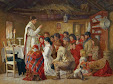
A homily for the Vigil Mass of Christmas. This congregation will largely consist of families with children.
Tonight we are waiting. The world has always been waiting. Mankind has always felt the need for salvation; we have always known that things are ‘just not right’ and have called out to God asking Him to intervene and straighten things out.
More than two and a half millennia ago, the prophet Isaiah spoke of this need for salvation. Politically and morally Jerusalem was in a bad way; once again, the Chosen People had turned their back on God. But the Holy Spirit spoke through Isaiah and gave him words of comfort. God would intervene to put things right for mankind – the land that was called Foresaken and Abandoned would receive a new name: My Delight and The Wedded. The Chosen People are called to trust again in the Lord. God would put things right. But how would this be done?
Would God intervene with great power – destroying the evil and rewarding the good? Would He raise up a new king of Israel to establish a state of justice and peace? Hoping for a powerful God who judges is a risky proposition – can we really be confident that we would end up in the right? And, could we ever think that any earthly king or state can put things right, when the real problems of the world are found within human hearts.
The answer that God gives is the reason for our celebration. He does not come in power and might. He does not come as an earthly king. He sends his Holy Spirit to the Virgin Mary and she is found to be with child. He Himself took flesh from the Virgin. This is why the Old Testament calls Him Emmanuel - God is with us. God Himself became a little baby – a baby called Jesus, a name meaning Saviour. And how does He save us? He does not do so with brute power and might, but the strange weapons of weakness, innocence and love – the weapons by which a little baby can win our hearts.
By coming into the world as a child, God makes possible a new relationship with Him. He makes Himself small so that He is no longer far away from us. He shows us that His love for us is so great that He wants to enter into our world, into our lives and make Himself defenceless in front of us.
By coming to us as a baby He invites us to open our hearts to Him. This is where His salvation begins – by driving out hatred, bitterness and sin and replacing it with His love. During the year we will celebrate His teaching, His Passion, His Cross, His Resurrection and His sending of the Holy Spirit – but tonight our focus is on the beginning. At the beginning is the baby. We look at the little baby in the crib and our hearts open; we learn that He is our God and we realise that the whole world has been changed. We know that the world is not Foresaken or Abandoned, but that Heaven and Earth have been wedded to each other, and God has come to change us so that he might truly delight in us. We know that God has come close to us, and has poured His grace and His love into our world, and for that we give thanks on this Holy Night.
Pope Benedict wrote a letter about hope about a month ago which explains what this mystery of the baby in the crib means to us. He writes: Through him we have become certain of God, a God who is not a remote “first cause” of the world, because his only-begotten Son has become man and of him everyone can say: “I live by faith in the Son of God, who loved me and gave himself for me” (Gal 2:20) [Spe Salvi 26]
I’d like to say a word to the children now. I’m sure you’re all very excited about Christmas, about Christmas dinner and sweets and presents and so on. I hope you all have a fun Christmas. But don’t forget what the fuss is really about – take a little time to look at the baby Jesus in the crib – at home or here in the Church. We are celebrating His birthday at Christmas; so take some time to thank Him for coming into the world to be our best friend who helps us to live good and holy lives. Adults, we could do worse than do the same.
Showing posts with label Isaiah. Show all posts
Showing posts with label Isaiah. Show all posts
Sunday, December 23, 2007


Sunday, December 2, 2007
A Homily to be Preached at a Public Mass in Convent of Augustinian Nuns
3rd December 2007 - Monday of the 1st Week of Advent (Readings)
[Please pray that this will still be understandable when I render it into Italian]
Sisters and brothers, we find ourselves at the start of the new liturgical year, during the season of Advent. This word Advent comes from the Latin verb advenio and refers to the arrival or coming of the Lord. It is a time of preparation and expectation. Despite not having the strong penitential character of Lent, it is a sober time and one during which we are encouraged to have a conversion of heart in order that we might be ready to welcome the Lord when he comes. In short, Advent is a time of hope – because the Lord is faithful to his promises, and therefore our preparations will not be in vain.
It is therefore very fitting that the Holy Father should give us as an Advent-present his new Encyclical Letter, Spe Salvi. He addresses us his words on Christian hope, as we enter this period which is built around the hope of the Christian in the Coming of the Lord.
But what do we mean by the Coming of the Lord? Has not the Lord already come? Is Advent not just the preparation for Christmas, the feast that celebrates the Son of God entering the world? This is true, but our focus is elsewhere during the first half of Advent. We are invited to reflect on the Second Coming of the Lord. The word Advent, Adventus, translates into Greek as Parousia – the word used to refer to coming of the Lord in glory and judgement at the end of times. Looking around the world, we see that there is much injustice and suffering – and if history is to make sense, then there is need for a final, decisive intervention from above. What else does Isaiah mean when he speaks of “the blast of judgement and the blast of destruction” when “Lord will come and rest on the whole stretch of Mount Zion and on those who are gathered there, a cloud by day, and smoke, and by night the brightness of a flaring fire.”
The image is terrifying – but we must not be afraid. It is not intended as a threat but it is a call to responsibility and hope. The Holy Father tells us, “From the earliest times, the prospect of the Judgement has influenced Christians in their daily living as a criterion by which to order their present life, as a summons to their conscience, and at the same time as hope in God's justice.” (Spe Salvi, 41)
We hear the Lord speak of this same hour of justice in the Gospel when he says “many will come from east and west to take their places with Abraham and Isaac and Jacob at the feast in the kingdom of heaven.” Do not forget, He makes this promise in response to the astonishing faith of the Centurion. Let us take this Centurion as our model and welcome the Lord with humility. If we trust in Him and His justice, He we can be sure that will guide us through this season of preparation and make firm within us His hope.
[Please pray that this will still be understandable when I render it into Italian]
Sisters and brothers, we find ourselves at the start of the new liturgical year, during the season of Advent. This word Advent comes from the Latin verb advenio and refers to the arrival or coming of the Lord. It is a time of preparation and expectation. Despite not having the strong penitential character of Lent, it is a sober time and one during which we are encouraged to have a conversion of heart in order that we might be ready to welcome the Lord when he comes. In short, Advent is a time of hope – because the Lord is faithful to his promises, and therefore our preparations will not be in vain.
It is therefore very fitting that the Holy Father should give us as an Advent-present his new Encyclical Letter, Spe Salvi. He addresses us his words on Christian hope, as we enter this period which is built around the hope of the Christian in the Coming of the Lord.
But what do we mean by the Coming of the Lord? Has not the Lord already come? Is Advent not just the preparation for Christmas, the feast that celebrates the Son of God entering the world? This is true, but our focus is elsewhere during the first half of Advent. We are invited to reflect on the Second Coming of the Lord. The word Advent, Adventus, translates into Greek as Parousia – the word used to refer to coming of the Lord in glory and judgement at the end of times. Looking around the world, we see that there is much injustice and suffering – and if history is to make sense, then there is need for a final, decisive intervention from above. What else does Isaiah mean when he speaks of “the blast of judgement and the blast of destruction” when “Lord will come and rest on the whole stretch of Mount Zion and on those who are gathered there, a cloud by day, and smoke, and by night the brightness of a flaring fire.”
The image is terrifying – but we must not be afraid. It is not intended as a threat but it is a call to responsibility and hope. The Holy Father tells us, “From the earliest times, the prospect of the Judgement has influenced Christians in their daily living as a criterion by which to order their present life, as a summons to their conscience, and at the same time as hope in God's justice.” (Spe Salvi, 41)
We hear the Lord speak of this same hour of justice in the Gospel when he says “many will come from east and west to take their places with Abraham and Isaac and Jacob at the feast in the kingdom of heaven.” Do not forget, He makes this promise in response to the astonishing faith of the Centurion. Let us take this Centurion as our model and welcome the Lord with humility. If we trust in Him and His justice, He we can be sure that will guide us through this season of preparation and make firm within us His hope.
Subscribe to:
Posts (Atom)