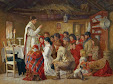
It's quite a common - and heart-breaking - thing these days for children to arrive into primary school aged 4 or 5 unable to bless themselves or not knowing the basic prayers such as the Our Father or the Hail Mary. I'm fortunate that the Primary School teachers in my parish schools are excellent and pray with the children throughout the day, but unless the habit of prayer is learned in the home, I fear that it will be something ultimately foreign to these children.The place to start is with your own prayers. There are many good prayer books that will help you to say some simple morning and night prayers so that you are used to spending a little time with Our Lord each day. You can also spend some quiet moments thinking about the truths of the faith (again there are some quite simple summaries available in many prayer books) and then asking Our Lord in your own words how to live well as a Catholic.[snip]
As soon as your child is able to walk and talk a little, that would be the time to kneel down and say some simple prayers, especially at bedtime. You can say prayers at your own choice; there are many good children’s prayer books that can help. It is also good if you say some traditional prayers such as the Our Father and the Hail Mary, and perhaps the Act of Contrition and the Prayer to the Guardian Angel. It doesn’t matter that your child doesn’t understand them fully as yet – he will start at school knowing these familiar prayers and will understand them better as he gets older.
I know that when I was growing up, bedtime prayers were the most natural thing in the world and a regular part of the daily routine. Prayer was as much a part of life as eating or breathing or brushing one's teeth. And that's as it should be. However, that tradition or habit seems to have been broken in most households these days. I sometimes wonder how that came to happen - how people who had learned to pray from their parents didn't pass on the same habits to their children. I suppose the most obvious answer is that they themselves had stopped praying, and therefore it wasn't part of their home-life when they had children. However, parents also want their children to grow up knowing God and receiving the sacraments, so they're not totally disengaged from a life of faith either.
I like that Fr Tim is so encouraging in his answer. Personally, I try to be encouraging as well when preparing couples for the baptism of their children. I remind them that one of the final blessings of the Baptism ceremony contains the prayer that they should be the first and the best of teachers of the faith in their children's lives. It's important for parents to realise that Church teaching and practice empowers parents and encourages them in their roles as parents. They are told clearly that they have an irreplaceable role and importance in their children's lives and that they themselves have the right and duty to pass on the best of values and a belief in God to their children. So many other influences in society seem to take away or minimise the parents' role. Children's television and the media in general do not affirm or encourage parenthood. The cult of youth puts out the message that the next generation should be free to make their own mistakes, and by the time children reach their early teens, I get the impression that most parents simply no longer know how or have the confidence to be parents to their own children. Maybe I'm naive, but I genuinely think that the Church can do some good by being more forthright in encouraging and supporting parents to be parents when children are young.
I also love the fact that Fr Finigan encourages this mother to pray with her unborn child. When I'm going through the baptism ceremony with parents in our preparatory class, I tell them that making the sign of the cross on their child's forehead should remind them as parents they can always bestow a blessing on their children. They can also make a point of praying with their children, even before the child knows what prayer is. I was chuffed to bits to discover that one of the first words learned by the first-born of a dear friend was "amen!" Tús maith, leath na hoibre!