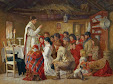
I think that we tend to under-rate the importance of this Feast and the event that it celebrates. I seem to recall reading that the Orthodox put much emphasis on Christ's Baptism in the Jordan as being one of the great Trinitatian theophanies - it's one of those rare times when the Three Persons make themselves 'visible'. We hear the voice of God the Father, God the Son Incarnate is baptized, and the Holy Spirit appears in the form of a dove.
Of course, part of the difficulty is in correctly interpreting that baptism. John's baptism was a baptism of repentance, so understanding why Christ submitted to it can cause difficulties. The Arians took Christ's baptism and the fact that He received the Holy Spirit at that time as evidence that He was not equal to the Father. Well-intentioned Christology which seeks to affirm Christ's divinity tends to downplay the importance of the Baptism of the Lord, reducing it to a mere gesture of humility. I'm inclined to think that such an over-simplification of things tends towards monophysitism - a rejection of the dogma of Christ's two natures, human and divine.
On the other hand, other theologians treat the Baptism as though it were the moment when Christ became divine, or as though He were just an ordinary man whose miracles and preaching derived purely from His having received the Holy Spirit at that time. Similarly, whilst it is evident that this Baptism was hugely significant in Our Lord's beginning his public mission, it would be a mistake to treat it as being the vocation-moment in His life when He realised who He was and what He had to do.
So, what is the Christological significance of the Baptism? Well, I shan't attempt to give a comprehensive answer, but I will highlight some aspects which strike me as important. Firstly, whilst Christ was sinless and not in need of forgiveness, I think that we can understand undergoing John's baptism as being more than just a gesture of humility or solidarity with the mass of sinful humanity. Rather, Christ is the Head of the Church and assumed a human nature which was marked by Adam's sin. He did not have the stain of Original Sin or the concupiscence which comes from it, but he did assume many weaknesses to which man is subject as a result of the Fall. It was therefore fitting that the Head of the Church should take part in the Baptism of repentance and thereby bring the Body with Him. Of course, it is the sacrifice of the Head which makes possible the repentance and salvation of the Body.
The Baptism is also profoundly a sign of acceptance - a prefigurement of His redeeming death. The logic of our sacramental relationship with Christ means that it makes perfect sense that if His baptism is a sign of His acceptance of His death, that our baptism allows us to share in the benefits of that sacrifice.
Sunday, January 11, 2009


Thursday, January 8, 2009
Various
Many thanks to Don Marco for posting an English Translation of the Holy Father's catechisis on Rom 12:1. My blog title is derived from that verse, and I took the concept of rationabile obsequium as a challenge to myself in the exercise of the priestly ministry.
Secondly, Kansas Catholic has some wonderful pictures of a first profession of vows by one novice and the investiture of four postulants by the Benedictines of Mary, Queen of Apostles. Amongst the 4 who received the habit was my good friend Sr Mary G.
Finally, may Fr Richard John Neuhaus rest in peace.
True Worship in ChristAlas, the current English translation of the Roman Canon fudges the following:
But the question persists: Then how should we interpret this "reasonable spiritual worship"? Paul always supposes that we have come to be "one in Christ Jesus" (Galatians 3:28), that we have died in baptism (Romans 1) and we live now with Christ, through Christ and in Christ. In this union -- and only in this way -- we can be in him and with him a "living sacrifice," to offer the "true worship." The sacrificed animals should have substituted man, the gift of self of man, and they could not. Jesus Christ, in his surrender to the Father and to us, is not a substitution, but rather really entails in himself the human being, our faults and our desire; he truly represents us, he assumes us in himself. In communion with Christ, accomplished in the faith and in the sacraments, we transform, despite our deficiencies, into living sacrifice: "True worship" is fulfilled.
Christ's True Sacrifice Made Present
This synthesis is the backdrop of the Roman Canon in which we pray that this offering be "rationabile," so that spiritual worship is accomplished. The Church knows that in the holy Eucharist, the self-gift of Christ, his true sacrifice, is made present. But the Church prays so that the celebrating community is really united to Christ, is transformed; it prays so that we ourselves come to be that which we cannot be with our efforts: offering "rationabile" that is pleasing to God. In this way the Eucharistic prayer interprets in an adequate way the words of St. Paul.
Quam oblationem tu, Deus, in omnibus, quaesumus, benedictam, adscriptam, ratam, rationabilem, acceptabilemquw facere digneris: ut nobis Corpus et Sanguis fiat dilectissimi Filii tui, Domini nostri Iesu Christi.
Secondly, Kansas Catholic has some wonderful pictures of a first profession of vows by one novice and the investiture of four postulants by the Benedictines of Mary, Queen of Apostles. Amongst the 4 who received the habit was my good friend Sr Mary G.
Finally, may Fr Richard John Neuhaus rest in peace.
Saturday, January 3, 2009
This Sunday's Readings...
We're fortunate in Ireland that the Feast of the Epiphany is celebrated on the 6th of January, so we have the wonderful readings of the 2nd Sunday after Christmas tomorrow morning. A friend of mine from seminary suggested that the core of the Gospel would be preserved if, through some freak occurrence, the New Testament were lost except for the Letter of St Paul to the Galatians. I keep meaning to re-read Galatians with that hypothetical scenario in mind in order to make sense of what he was saying.
As I was reading the 2nd Reading and Gospel of this Sunday's liturgy, I realised that a somewhat similar claim could be made about those two readings. Between them they manage to encapsulate much of what is most central to our faith. If one were to commit them to memory, one would have the answers to the most pressing existential and philosophical questions.
The Second Reading ( Ephesians 1:3-6. 15-18) summarises God's plan for us quite nicely:
Blessed be God the Father of our Lord Jesus Christ, who has blessed us with all the spiritual blessings of heaven in Christ. Before the world was made, he chose us, chose us in Christ, to be holy and spotless, and to live through love in his presence, determining that we should become his adopted sons, through Jesus Christ for his own kind purposes, to make us praise the glory of his grace, his free gift to us in the Beloved.The Gospel (John 1-1-18), on the other hand, is virtually a complete Credo and a summary of all that follows in John's Gospel:
That will explain why I, having once heard about your faith in the Lord Jesus, and the love that you show towards all the saints, have never failed to remember you in my prayers and to thank God for you. May the God of our Lord Jesus Christ, the Father of glory, give you a spirit of wisdom and perception of what is revealed, to bring you to full knowledge of him. May he enlighten the eyes of your mind so that you can see what hope his call holds for you, what rich glories he has promised the saints will inherit
In the beginning was the Word:Back in the day that (up to the words 'grace and truth') was recited by the priest at the end of Mass as the 'last Gospel'. There was a decided wisdom in repeating the richest of scriptural passages after each and every Mass.
and the Word was with God
and the Word was God.
He was with God in the beginning.
Through him all things came to be,
not one thing had its being but through him.
All that came to be had life in him
and that life was the light of men,
a light that shines in the dark,
a light that darkness could not overpower
A man came, sent by God.
His name was John.
He came as a witness,
as a witness to speak for the light,
so that everyone might believe through him.
He was not the light,
only a witness to speak for the light.
The Word was the true light
that enlightens all men;
and he was coming into the world.
He was in the world
that had its being through him,
and the world did not know him.
He came to his own domain
and his own people did not accept him.
But to all who did accept him
he gave power to become children of God,
to all who believe in the name of him
who was born not out of human stock
or urge of the flesh
or will of man
but of God himself.
The Word was made flesh, he lived among us,
and we saw his glory,
the glory that is his
as the only Son of the Father,
full of grace and truth.
John appears as his witness. He proclaims:
'This is the one of whom I said:
He who comes after me ranks before me
because he existed before me'.
Indeed, from his fulness we have, all of us, received –
yes, grace in return for grace,
since, though the Law was given through Moses,
grace and truth have come through Jesus Christ.
No one has ever seen God;
it is the only Son, who is nearest to the Father's heart,
who has made him known.
Sunday, December 28, 2008
Feast of the Holy Family
Whilst preaching today, I reminded the congregation that the Church is a great advocate of the natural rights of the family, and that parents in particular should familiarise themselves about what the Church has to say about their role. Ironically, on the radio this morning I heard a commentator complain about the Church's role in education. He didn't think it was fitting that the vast majority of Irish primary schools should have the local bishop as patron in 'Post-Catholic Ireland' and thought that the Constitutional provision in this regard needed revision because it was drafted by Archbishop McQuaid of Dublin. What precisely did he regard as needing to be changed? The following which he referenced explicitly:
Article 42.1 The State acknowledges that the primary and natural educator of the child is the Family and guarantees to respect the inalienable right and duty of parents to provide, according to their means, for the religious and moral, intellectual, physical and social education of their children.Part of this commentator's 'solution' to the 'problem' of most educational provision was a revision of that section of the Constitution which guarantees the rights of parents.
Thursday, December 25, 2008
Ahmadinejad's Alternative Christmas Message
There's been quite a fuss in the UK because of Channel 4's decision to broadcast an 'Alternative Christmas Message' from Iran's Mahmoud Ahmadinejad. That's an interesting collaboration between radical Islam and a decidedly left-of-centre TV station.
Now, I'm not an expert in Islamic theology, but it's interesting to compare Ahmadinejad's opening paragraphs with the Christian understanding of what Christmas is really about.
(Note also - Ahmadinejad says that God created "human beings for Himself". The classical Christian Catechism answer to the question as to why God created us is so that we might know and love him. Our doctrine of God as a Trinity of love does colour our understanding of our own purpose.)
Now, I'm not an expert in Islamic theology, but it's interesting to compare Ahmadinejad's opening paragraphs with the Christian understanding of what Christmas is really about.
"In the Name of God the Compassionate, the Merciful.The initial impression is of an austere God who, although he does not 'leave humanity to its own devices' is not the Incarnate God of Triune love who is himself our Saviour. Likewise, his description of humanity's struggle "from dust to the divine" has distinct Pelagian tones - a Christian would be much more aware of our need for divine grace and the implications of our fallen state. A prophet can only inform and exhort. Christ establishes a true communion of love between God and man for our salvation.
Upon the anniversary of the birth of Jesus, Son of Mary, the Word of God, the Messenger of mercy, I would like to congratulate the followers of Abrahamic faiths, especially the followers of Jesus Christ, and the people of Britain.
The Almighty created the universe for human beings and human beings for Himself.
He created every human being with the ability to reach the heights of perfection. He called on man to make every effort to live a good life in this world and to work to achieve his everlasting life.
On this difficult and challenging journey of man from dust to the divine, He did not leave humanity to its own devices. He chose from those He created the most excellent as His Prophets to guide humanity.
All Prophets called for the worship of God, for love and brotherhood, for the establishment of justice and for love in human society. Jesus, the Son of Mary, is the standard-bearer of justice, of love for our fellow human beings, of the fight against tyranny, discrimination and injustice.
(Note also - Ahmadinejad says that God created "human beings for Himself". The classical Christian Catechism answer to the question as to why God created us is so that we might know and love him. Our doctrine of God as a Trinity of love does colour our understanding of our own purpose.)
Wednesday, December 24, 2008
Christmas Homily
After the passage of countless centuries from the creation of the world, when in the beginning God created heaven and earth and formed man and woman in his own image, and very many centuries from the time when after the flood the Almighty had set his bow in the clouds, a sign of the covenant and of peace; in the twenty-first century from the migration of Abraham, our father in faith, from Ur of the Chaldees; in the thirteenth century from the departure of the people of Israel from Egypt under the leadership of Moses; in about the thousandth year from the anointing of David as king according to the prophecy of Daniel; in the one hundred and ninety-fourth Olympiad; in the seven hundred and fifty-second year from the foundation of the City of Rome; in the forty-second year of the rule of Caesar Octavian Augustus; while the whole world was at peace, Jesus Christ, eternal God and Son of the Eternal Father, desiring to consecrate the world by his most gracious coming, having been conceived of the Holy Spirit, and when nine months had passed after his conception, is born as man in Bethlehem of Judah from the Virgin Mary: the Nativity of Our Lord Jesus Christ according to the flesh.[1]
There are many ways in which we could try to date the event we celebrate this evening. The Ancient Greeks counted out the years between one Olympic Games and another, putting the birth of Christ in the 194th Olympiad. The Romans counted from the year their own great city was founded, and marked out time according to the reigns of their emperors. St Luke, when he was writing the history of Christ pinned down that first Christmas by reference to the fact that Quirnus was governor of Syria. Since then, empires have fallen and risen, and all those ways of marking time have fallen into disuse. We now count our years as AD and BC. AD –in the year of our Lord, BC – before Christ.
Christ was born into a world where dates were marked by reference to the great men of the time, or some historical event. Now, however, every time we read a date or talk about an event in history, we mark the time by reference to what happened on that holy night in Bethlehem. The death of Julius Caesar in 44 BC, the fall of the Roman empire in 476 AD, the great Fire of London in 1666, the 1916 Easter Rising, September the 11th 2001. The way we number our years reminds us that all of human history can be divided into a before and an after… the preparation for the coming of Christ, and the new era which began with His birth. Cardinal Newman once wrote, “Christ … came to make a new and better beginning of all things than Adam had been, and to be a fountain-head from which all good henceforth might flow.”[2] Tonight we celebrate that new and better beginning, when God himself was born into this world as a little baby.
Look at the crib. Step back from the romance of it for a moment, and it does not look like a promising beginning. A family, forced to leave their home so that they might be taxed, a mother who finds no place to give birth to her baby, but a stable. A baby, wrapped up tight in swaddling clothes, unable even to lift his arm. And yet, this baby, this little child is not only the King promised to the Israelites, but is the Son of God Himself.
It is a scene of love, and of joy too, no doubt. Mary and Joseph rejoice in the birth of his child, but to human eyes it seems an unpromising and poor beginning for a child's life, and not at all like God's new beginning for us all.
The angels know better, they sing, “ Glory to God in the highest heaven, and peace to men who enjoy his favour.” They see what we now know by faith. They see in that little child God’s favour, God’s generosity to us all. They see what we struggle to understand – that God made himself weak so that all men and women might know Him, love Him and receive His peace, His salvation. The angels see that God does not want to gather his straying children by a show of force, but wants to share our human life so that He can transform it from within. He wants to walk with us, so that we can learn from one like ourselves, He wants to suffer for us, so that He will never be far away when we suffer, He wants to die for us, so that we might no longer have anything to fear from sin and death.
That is what we celebrate tonight. Our ancestors knew how to celebrate this feast, even when they lived in a hardship we can’t imagine. There is the old custom of lighting a candle in the window each Christmas so that Mary and Joseph might have light to guide them on their journey. There was also the custom of setting food out on the table so that the Holy Family might have something to sustain them in their travels. The light of that candle also promised safety to the priest in times of persecution and a welcome to the wanderer in times of hardship. The food was not only for the Holy Family, but was to be shared with anyone who had need.
These customs show that those who went before us realised two things. In their concern for the Holy Family they realised that when Christmas is celebrated, the events which happened in Bethlehem are not trapped in the past… The birth of Christ still matters today, still has effects for us today, and if we celebrate Christmas well, we can, in a sense, be brought back to that stable, to gaze on the Child Jesus and welcome Him with joy!
The second thing they realised is that the celebration of this feast should lead us into a greater love and generosity for those around us. The new and better beginning must take hold in our hearts… If we welcome Christ at Christmas, and if we welcome him in the Eucharist, then we must give birth to Christ ourselves, by having a more Christ-like heart. We must not be afraid to be more generous, more forgiving, more loving, more prayerful, more humble. We must not be afraid to let the idealism and the joy of Christmas touch our hearts. Christ came into the world poor so that our souls might be made rich through him.
“Mary treasured all these things, and pondered them in her heart.” May her prayers help us to give Christ a true welcome this Christmas.
Monday, December 22, 2008
Holy Father's Christmas Address to the Roman Curia
I like to keep an eye on the Pope's Christmas address to his collaborators in the Roman Curia. Remember, it was in the context of his first such address that he coined the term Hermeneutic of Continuity.
Well, this year's address (link to Italian version) was interesting, with the Pope making a number of sharp points. Rocco analyses what he had to say about World Youth Day.
Also of interest is the following passage:
I'll try and post an English translation of the more important bits when it's available.
Well, this year's address (link to Italian version) was interesting, with the Pope making a number of sharp points. Rocco analyses what he had to say about World Youth Day.
"The uniquness of the [World Youth] days and the particular character of their joy, their creative force of communion, can find no explanation. Above all it's important to take into account the fact that the World Youth Days do not consist solely in just the one week where they're publicly rendered visible to the world. It is a long road, interior and exterior, that leads to them. The Cross, accompanied by the image of the Mother of the Lord, makes a pilgrimage across countries. Faith, in its way, needs to see and touch. The encounter with the cross, which comes to be touched and carried, becomes an internal encounter with the One who took up the cross and died for us. The encounter with the Cross sustains in the soul of the young the memory of that God who wanted to make himself man and suffer alongside us. And we see the woman given us as our Mother. The solemn Days are but the culmination of a long road, along which we find one another and go together to encounter Christ. Not just in Australia did the long Via Crucis cross the city and become the culminating event of these days. It likewise reflected again all that happened in the years preceding it and pointed to Him who reunites together all of us: that God who so loved us even to the Cross. So, too, the Pope is not the star around which it all unfolds. He is totally and merely the Vicar. He returns to the Other who is in our midst. Finally the solemn liturgy is the center of this togetherness, for in it comes that which we cannot realize and which, still, we are always awaiting. He is present. He enters among us. The heavens are torn and the earth is made luminous. It's this that renders life light and open and unites the many ones with others in a joy that is incomparable with the ecstasy of a rock festival. Frederich Nietzsche once said: "The ability is not in organizing a party, but in finding the people able to bring it joy." According to Scripture, joy is the fruit of the Holy Spirit (cf Gal 5:22): this fruit was abundantly perceivable in the days of Sydney. And just as a long road precedes the World Youth Days, a path following it is likewise drawn. Friendships are formed that encourage a different lifestyle and that sustain it from inside. The great days have, not an ending, but the scope of sustaining these friendships and of making places of life in the faith rise in the world where, together, hope and love can be seen.And what's the subtext? Rocco speculates as follows:
During WYD Sydney, a leader of the Aussie branch of the Society of St Pius X -- the schismatic traditionalist group -- knocked the weeklong event as a "happy party" with "very little that is truly holy and sacred and prayerful" in it.Interesting! WYD 2000 in Rome was a crucial event for myself personally and a major help in encouraging me to pursue my priestly vocation.
Also of interest is the following passage:
Poiché la fede nel Creatore è una parte essenziale del Credo cristiano, la Chiesa non può e non deve limitarsi a trasmettere ai suoi fedeli soltanto il messaggio della salvezza. Essa ha una responsabilità per il creato e deve far valere questa responsabilità anche in pubblico. E facendolo deve difendere non solo la terra, l’acqua e l’aria come doni della creazione appartenenti a tutti. Deve proteggere anche l’uomo contro la distruzione di se stesso. È necessario che ci sia qualcosa come una ecologia dell’uomo, intesa nel senso giusto. Non è una metafisica superata, se la Chiesa parla della natura dell’essere umano come uomo e donna e chiede che quest’ordine della creazione venga rispettato. Qui si tratta di fatto della fede nel Creatore e dell’ascolto del linguaggio della creazione, il cui disprezzo sarebbe un’autodistruzione dell’uomo e quindi una distruzione dell’opera stessa di Dio. Ciò che spesso viene espresso ed inteso con il termine "gender", si risolve in definitiva nella autoemancipazione dell’uomo dal creato e dal Creatore. L’uomo vuole farsi da solo e disporre sempre ed esclusivamente da solo ciò che lo riguarda. Ma in questo modo vive contro la verità, vive contro lo Spirito creatore. Le foreste tropicali meritano, sì, la nostra protezione, ma non la merita meno l’uomo come creatura, nella quale è iscritto un messaggio che non significa contraddizione della nostra libertà, ma la sua condizione. Grandi teologi della Scolastica hanno qualificato il matrimonio, cioè il legame per tutta la vita tra uomo e donna, come sacramento della creazione, che lo stesso Creatore ha istituito e che Cristo – senza modificare il messaggio della creazione – ha poi accolto nella storia della salvezza come sacramento della nuova alleanza. Fa parte dell’annuncio che la Chiesa deve recare la testimonianza in favore dello Spirito creatore presente nella natura nel suo insieme e in special modo nella natura dell’uomo, creato ad immagine di Dio. Partendo da questa prospettiva occorrerebbe rileggere l’Enciclica Humanae vitae: l’intenzione di Papa Paolo VI era di difendere l’amore contro la sessualità come consumo, il futuro contro la pretesa esclusiva del presente e la natura dell’uomo contro la sua manipolazione.In brief, the Pope is reminding us that the Church has a responsibility for creation. However, this isn't only about protecting the environment - we are also called to develop an "ecology of man" whereby we stop ourselves from destroying ourselves. Central to this understanding of humanity is the Church's recognition of the relationship between man and woman. The reduction of 'gender' to the status of a social construct is to ignore God's plan and the fact that God speaks to us through creation - man being the image of God, for example, and the analogy between marriage and the covenant.
I'll try and post an English translation of the more important bits when it's available.
Subscribe to:
Posts (Atom)